Now that the XAT is over, the time to dive fully into WAT-GD-PI prep has come. But how does one go about it? It all seems like a vast sea with no beginning and no end. A single post covering all three — WAT, GD & PI — will be unwieldy, to say the least, so I will do a series of posts that will help you kick-start your prep for the second stage.
I have always preferred a test without sectional time limits since it tests a crucial quality required for management — optimizing resources to achieve maximum return on investment. In this case, the resources are your own skills, and the investment is your time.
So, how does one go about using the 170 minutes on the XAT?
This piece on Decision Making has really expanded and I hope as I begin to write this post that this will be the closing piece that concludes this and this.Read More
In the previous post,we discussed how Decision Making can be the undoing of XAT aspirants and tried to understand the nature of questions that come up on the section.
We took up two sets from the Decision Making section of a past XAT and discussed a structure to answer DM questions. In this post, we shall look at the remaining questions from that paper.
One of the most tedious and inscrutable sections that you will find across all management entrance tests, Decision Making has been the nemesis of many a XAT aspirant. A lot of factors contribute towards DM possibly being the biggest stumbling block on the XAT. But none is bigger than the fact the amount of time any test-taker would have spent preparing for DM when compared to any other section is minuscule. This coupled with the dislike and unease most aspirants have towards reading, and the extremely subjective nature of questions ensures that DM ends up becoming the deal-breaker as far as the XAT is concerned. Read More
A curious phenomenon repeats itself year after year when the results of the CAT and the XAT come out – there is little overlap between the students who crack CAT and those who crack XAT. In other words, a largely different set of test-takers ends up cracking each test.
Why is this so? It is almost like one of the GMAT CR question types – which of the following provides the best explanation for the phenomenon described above?
The answer(s) to this question will also hold the key to know how to prepare to ace the XAT!Read More
Be it the day of the CAT or be it when the final admit results come out it is not easy to be a mentor — on one hand you are happy for students who crack the exam and get admitted and on the other hand you feel sad for those who have a bad test day or fail to convert. The toughest thing was always to meet a student who was happy, knowing that the one waiting outside was sad. So with the years, one develops a certain equanimity since one cannot be so happy that one is not able to empathize with the ones who are having a hard time and one also cannot get so bogged down by sadness that one cannot partake in the joy of the successful.
In some cases students just disappear, somehow they take it very personally, that they have failed, they have failed even after reading all the blogs and attending all the sessions, they feel almost as if they have let me down. And I am left wondering, whatever happened to that guy, that girl. The others thankfully come down to meet me or reach out to me through the blog comments even if it is just to feel lighter instead of heavy and burdened.
There are two things about cliches — they are dead boring since they have been repeated so often but at the same time, they are also true, so are all the cliches about failure, I won’t repeat them but I will attest that they are true.
In one of the recent posts, I spoke about how everyone has to face a test and how heroes in myths are defined by overcoming obstacles. The thing about myths is that they rarely show heroes failing at a task spectacularly. But if we look at real-life successes, almost every spectacular success has had a big failure or inability as well. I am not linking failure to success or calling it a pre-requisite.
All I am saying is, everyone fails, so do not go beating yourself about it.
There is nothing to be gained from self-flagellation
The first reaction understandably is to hit oneself with an emotional whiplash and of these, the worst one is — I am useless, I am not smart enough, I suck, I do not have the skills to crack this exam, no matter what I do it will not change a thing.
Firstly, I will be happy if you are telling yourself all of these in anger rather than through a bucket of tears since anger with oneself can be a very good motivator.
But whether you are telling yourself these things through anger or through tears you need to quickly move from “I suck” to I suck at this particular aspect of CAT, from being emotional to being strategic.
This was the first time I took an entrance test and I was overwhelmed by it
My reading speed was the biggest hindrance when the paper became tough
Before the test, I did not talk myself through what I was going to execute during the three sections
Before the test, I did talk myself through things but everything went out of the window once the test started
I did not hunker down and solve 2 DI sets but flitted from set to set
I could not solve tough QA questions from Arithmetic, my level plateaued at easy and moderate questions
My technique to solve evaluative RC questions was not really up to the mark
My favorite story when it comes to dealing with doubts about one’s ability is Brian Lara’s answer when questioned about being McGrath’s bunny (he has got him quite a few times), Lara did not talk about the number of centuries he scored against Australia or the single-handed manhandling of a peak Australian team over an entire series, all he said was — someone from the opposition has to get me out sometime, right?
Evaluate the extent of damage and your options and view things in proportion
The right lens to view things should not be through your success or failure at CAT but in terms of your prospects of doing an MBA from a premier B-school.
Just like the extent of damage in a war varies across the various battlefronts, the damage, if any, to your MBA dreams, varies across different profiles.
Who are the aspirants who are the worst hit?
Those who already have 4 years of work experience and had a horrible CAT are the worst hit since another shot at the CAT and the 2-year MBA is effectively ruled out; they only have the rest of the exams in this season to make it count. (It is not that you will get rejected, you can still get an admit into a 2-year program but the number of recruiters looking at a 5-year profile will be fewer; you will still be able to get the career growth you are looking for in your domain)
Those who have three years of work-ex will still have a shot at the CAT next year but to stay close to the average profile in a b-school (having 4 or more years of work-ex will make the profile a bit of an outlier) they should crack one of the remaining exams in this season.
Those who have 2 or fewer years of work-ex have nothing to worry about as far as their MBA dreams go — they are well and truly alive. You can still get there, not when you wanted to and in the way you wanted to but you can still get there.
Some of you might wonder whether you have it in you to take another shot. Well, you do not have another option.
Roger Federer played from 2012 Wimbledon to 2017 Australian Open, 17 Slams, without winning a single slam, being stuck at 17, losing to players who were not in the same league as him. At every single slam during those five years my friend and I would talk, just before the semis or finals, about how well Fed was playing, the new things that he was inventing — the SABR (Sneak Attack By Roger) — and as usual the crazy points in the matches until then, only for him to lose again.
There were articles asking why he was still playing. I was supporting him saying that it need not be #1 or nothing, as long as he is easily making finals and semis and believes he can win he should play since he is still ranked in the top 4 and since unlike in a team sport, he is not delaying a transition or eating into the prime years of a youngster. In effect, I had mentally ruled out the chance of him winning again, I was happy that he was competing well.
Federer is great not because he has won 20 Slams but because he believed in himself so much, believed in himself through four years of heart-breaking failures, four years of aging and his body breaking down in 2016, while others were catching up with him.
I am sure no victory tasted sweeter to him than the 2017 Australian Open when he finally won a Slam again. (I have never felt more elation at the end of a sports match than while watching him win the 2017 Australian Open)
All of you are so young! This exam season is still young! And you have enough time to acquire the skills your skills to crack the CAT at another shot (if required).
Cut all the negative voices out of your head, your own voice, and that of your parents as well, if necessary (since all most Indian parents seem to care about is the timing of your wedding and how another CAT attempt affects that).
They will release the paper with your response soon and based on that we will release a tool to calculate your score — this can cause another meltdown. It is never easy to actually see the marks if you know you did not do well. Do not try to find out, let the results come out when they come out.
Some of you might be raring to smash the other tests to smithereens, and others might be feeling out of gas and motivation to pick yourself up.
The latter, please give yourself a break, do the things you like to do, eat the things you like to eat, and relax for the rest of this week, restart next Monday.
There is little you can do right by pushing yourself without a break or good rest and being a bunch of ragged nerves.
Getting ready for the next event
It is not easy to crack the test on your first or second attempt unless you are on the top of your game for at least 10 to 15 mocks with additional reserves to handle a tougher-than-usual paper. I cleared the test on my second attempt.
Even those who have set their sights firmly on the old IIMs will be taking a few more tests, at least the XAT. Now that you have the CAT monkey off your back, go ahead full-throttle on these other tests.
Even if you have decided on another shot at the CAT and IIM-A, take the other tests you have registered for seriously, crack a final admit to IIFT, NMIMS, SIBM, or even XL, and then reject it. — achieve something this season and set yourself higher goals for next year.
Some of the comments to this post are very good and some of you might find an echo of your performance, current state, and questions in them.
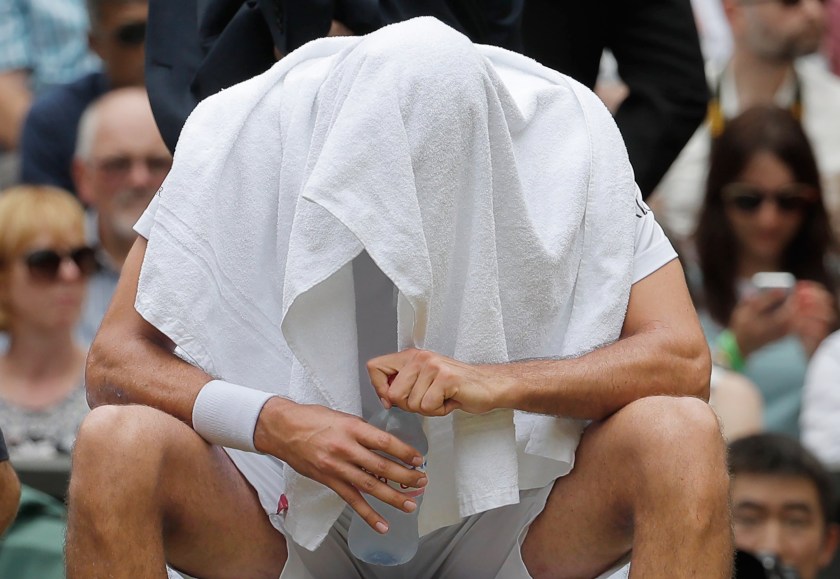
P.S: The picture with this post is not of Federer but of Marin Cilic (crying) after he lost the 2017 Final to Federer.
“Before enlightenment, chop wood, carry water. After enlightenment, chop wood, carry water.”
You have about a few days left and some of you might still be awaiting answers to some questions such as whether should you listen to what happened in the earlier slots, what should you do if you know you might not get sleep Saturday night, etc.
Last year I made an audio clip (initially shot as a video) that answered all of these queries, queries that deal specifically with the three days leading up to the test, and all the pending questions.
As on every Friday before the CAT-day, we are doing a stress buster session — Anything But CAT.
We will host five rooms where we will discuss specific non-CAT topics of interest: Cricket & Tennis, Football and other sports, Harry Potter & Fantasy Books, Music Room, Quizzing.
I’ll be handling the Cricket & Tennis room along with Amit Sir and Param Sir (and all of our other stalwarts will also be there in each of the other rooms).
I am looking forward to evening sessions and interacting with all the cricket, tennis, and sports fans among you. We will discuss the Tennis GOAT Debate, MSD, and sports heroes, and answer/discuss all non-CAT things in the Q&A!
All IMS students will receive a link for the same.
I did my last webinar for the season recently but there will still be a few non-prep queries that will be swirling around in your head. This post is will cover all of those niggles that do not prevent you taking to the field but are a bother that you can do without.
Is there a chance you might have burnt out or are running solely on adrenaline?
Those of you who have attended all of my webinars know how much store I set on having optimal mental energy. So for me a lot of issues can be traced back to the quality of our mental energy. Some of you might not realise that you have depleted your energy sources and are running solely on adrenaline
Ask yourself the following questions?
Do you feel fresh and mentally alert throughout the duration of the test?
Do you tend to flag after DI-LR?
Do you feel as fresh as you felt months ago when you began the prep?
Do you need to pump yourself up and motivate yourself to gather enough energy to take a test?
From the answers to the questions above you will know the state of your mental energy right now. Ideally, you should be feeling alert and light from the time you wake up until the time you go to sleep.
There are about 10 days left to the test and it is not too late to shift your focus from practising crazily to building up energy reserves to handle D-day, which as you know will demand more energy than a mock taken in the comfort (or discomfort) of your room.
Another obliquely related post that I think you should read (or re-read) if you haven’t is this one.
Between these two I think you will find what you need to get into the right state and manage your energies.
I got the worst slot — the super early morning slot!
For some the early morning slot might be a blessing in disguise since that is the time when you usually prepare, for night-owls it can be their worst nightmare come true.
Either way, you need to start tuning your biological rhythms to ensure that you reach the exam centre by 7 A.M and by 8:30 A.M you are absolutely fresh and raring to go.
If I were you I would do the following for until D-day:
Having had a light dinner by 8 PM
Ensure that I turn in by 10 PM
Wake up at 5 AM and get fresh by 6 AM (all you need to leave for the exam centre is to wear your clothes)
Do a small round of breathing exercises and meditation for a total of around 10-15 minutes
Read a chapter of any spiritual book or text that helps you go into the right frame of mind (5 minutes)
Have a breakfast involving one or more — bananas, soaked almonds, oats, eggs (if your centre is in a different city then soaked almonds and bananas are the easiest option)
Get ready to leave (during the run-up to the test, start your preparation)
Obviously this has to be modified by you to account of the travel time to the exam centre.
I do not know if 12:30 is a good slot or a bad slot!
If I have to choose a slot among three to take the test, I would choose 12:30, it is a bit later than the time at which I am at my optimal, 11:00 to 14:00, but I would not complain the way I would with 8:30, which is way too early for me, and 4:30, which would mean getting out in the afternoon (something I hate :-))
The thing with the 12:30 slot is that like the early morning slot you have to slightly alter your biological rhythms, your body is programmed to feel hungry between 1 and 2, over the next ten days you need to reprogram it.
The following would be my plan until D-day
Wake up at whatever my usual time is but not later than 8 AM and get fresh in an hour (all you need to leave for the exam centre is to wear your clothes)
Do a small round of breathing exercises and meditation for a total of around 10-15 minutes
Read a chapter of any spiritual book or text that helps you go into the right frame of mind (5 minutes)
Have something super-light at whatever your breakfast time is (maximum before 9) to trick your body into believing that everything is the same — I would suggest two bananas and some soaked almonds
Start your prep or log in to work
Have a proper breakfast just before the time you would need to leave for the test centre on D-day to reach there by 11 A.M — oats, eggs, upma, whatever floats your boat but nothing too heavy
Resume your prep or work
Those with the 4:30 slot need to do nothing different! Just go about things the way you normally do since it is neither a feeding or a digestion slot for the body!
It goes without saying that everyone should try to take SimCATs in the time-slot of the actual test.
Insomnia induced by test-day nerves
I am sure there are those of you who know that you will not be able to sleep the night before the CAT. The sheer nervousness, you are sure, will have you tossing and turning all night.
Even in this case, the best option is to pull an all-nighter two nights before the CAT and not sleep during the day that follows so that the night before the CAT, fatigue will overcome nervousness and your body will crash to sleep. Do not leave this for the end, try it once or twice before.
Managing your diet in the lead-up to the test
I was surprised to get a query around the kind of diet one should have but then I also remember talking to my colleagues about physical fitness for test-taking, so in a way, the question is very relevant.
I will try to answer the question from whatever little reading I have done and whatever experiments that I have done with respect to diet and I will try to keep it really simple. This is something that everyone can take up irrespective of the slot.
Food can help you feel two ways, one — extremely happy, satisfied, heavy, and ready to hit the sack, which is what happens when you have food that you and maybe most people really like such as biriyanis, and desserts (you get the drift). This state of body and mind after this is perfect for watching something silly while lying down and going off to sleep. As someone who really likes food and can really eat a lot, I have done a lot of this in the past and treat myself to this feeling of satiation twice a month (usually immediately or the day after a webinar :-))
The other thing that I have also done is have phases where food made me feel another way — nourished and light, exactly the way one feels after eating some fruit.
Given that all of you want to crack the third or fourth toughest test in the world (JEE, UPSC, Gaokao) I suppose you know which one of the two options you are supposed to choose.
So just eat a certain amount of fresh foods (fruits and nuts) and food that is not fried, overtly spicy, and oily (the non-vegetarians, please savour the meat and eat smaller portions), basically home-cooked food in moderation (delete the food apps on your phone)
Also, stop eating when you are just about three-fourths full do not crave for the feeling of heaviness. I have found that even milk makes me feel heavy or rather makes me aware of my gut and I hence cut it out of my system, you should try it as well.
And yeah, no snacks, at all, nothing out of a plastic packet, they don’t just make you feel heavy but bloated and make you crave strong flavours.
Ensure that you include some amount of light exercise every day
One thing that is least talked about is the importance of exercise for mental activities such as test-taking and I cannot vouch for this more. Whenever I sit at my desk for a long time, after a point I feel stale as if my brain is not working, all I need then is a good short walk and get the blood flowing through the body again. Movement is what gets oxygen into our system and makes us feel fresh.
It has been proven that sitting for long periods of time has many harmful effects and I know professionals who have desks that can be adjusted for height so that they can stand and work. You do not need to get one now but you need to counter the effects of sitting for a long time at your desk to prepare long with college or work.
All you need to do is a light exercise at an intensity that only at the end of 30 minutes will make your breath reach your mouth, and perspire slightly. You should not be panting, and your t-shirt should not be drenched. I would suggest a walk or a jog early in the morning or late at night or Yoga or (light) weight training for those who are already doing it.
As I have said before I cannot think of a better thing than adding a few breathing practices to your day.
Some of you might be thinking, is all of this really necessary?
Well, yes and no.
If you are my friend who is a 12-time 100-percentile or one of his students who had a 100 the year before last and scored just a mark or two fewer than him, you do not need any of this. These guys are at a level way beyond the test and the test doesn’t need them to stretch. If these guys have to compete on a different exam with many more people at their level I am sure they would also benefit from being in prime physical shape. But everyone else, including yours truly, can get better by being really fit.
Magnus Carlsen, the current world chess champion and the player with the highest ELO rating ever, does a lot of exercise work as well, he works out every single day, basically a lot of aerobic training. He says it crucial to be able to sit and think for hours at a stretch, so yeah, if Carlsen does, you and I should as well.







 The CAT Writer