Be it the day of the CAT or be it when the final admits results come out it is not easy to be a mentor — on one hand you are happy for students who crack the exam and get an admit and on the other hand you are also tinged with sadness for those who have a bad test day or fail to convert. The toughest thing was always to meet a student who is happy, knowing that the one waiting outside is sad. So with the years one develops a certain equanimity since one cannot be so happy that one is not able to empathise with the ones who are having a hard time and one also cannot get so bogged down by sadness that one cannot partake in the joy of the successful.
In some cases students just disappear, somehow they take it very personally, that they have failed, they have failed even after reading all the blogs and all attending all the sessions, they feel almost as if they have let me down. And I am left wondering, whatever happened to that guy. The others thankfully come down to meet me or reach to me through the blog comments even if it is just to feel lighter instead of heavy and burdened.
There are two things about cliches — they are dead boring since they have been repeated so often but at the same time, they are also true, so are all the cliches about failure, I won’t repeat them but I will attest that they are true.
In one of the recent posts, I spoke about how every one has to face a test and how heroes in myths are defined by overcoming obstacles. The thing about myths is that they rarely show heroes failing at a task spectacularly — they only show heroes’ failings or weaknesses (Rama in the way he treated Sita post his rescuing of her).
But if we look at real life successes, almost every spectacular success has had a a big failure or inability as well. I am not linking failure to success or calling it a pre-requisite.
All I am saying is, everyone fails, so do not go beating yourself about it.
There is nothing to be gained from self-flagellation
The first reaction understandably is to hit oneself with an emotional sledgehammer and of these the worst one is — I am useless, I am not smart enough, I suck, I do not have the skills to crack this exam, no matter what I do it will not change a thing.
Firstly, I will be happy if you are telling yourself all of these in anger rather than through a bucket of tears since anger with oneself can be a very good motivator.
But whether you are telling yourself these things through anger or through tears you need to quickly move from “I suck” to I suck at this particular aspect of CAT, from being emotional to being strategic.
- This was the first time I took an entrance test and I was overwhelmed by it
- My reading speed was the biggest hindrance when the paper became tough
- Before the test I did not talk myself through what I was going to execute during the three sections
- Before the test I did talk myself through things but everything went out of the window once the test started
- I did not hunker down and solve 2 DI sets but flitted from set to set
- I could not solve tough QA questions from Arithmetic, my level plateaued at easy and moderate questions
- My technique to solve evaluative RC questions was not really upto the mark
My favourite story when it comes to dealing with doubts about one’s ability is Brian Lara’s answer when questioned about being McGrath’s bunny (he has got him quite a few times), Lara did not talk about the number of centuries he scored against Australia or the single-handed manhandling of a peak Australian team over an entire series, all he said was — someone from the opposition has to get me out some time, right?
Evaluate the extent of damage and your options and view things in proportion
The right lens to view things should not be through your success or failure at CAT 2020 but in terms of your prospects of doing an MBA from a premier b-school.
Just like the extent of damage in a war varies across the various battlefronts, the damage, if any, to your MBA dreams, varies across different profiles.
Who are the aspirants who are worst hit?
Those who already have 4 years of work-experience and had a horrible CAT 2020 are the worst hit since another shot at the CAT and the 2-year MBA is effectively ruled out; they only have the rest of the exams in this season to make it count.
Those who have three years of work-ex will still have a marginal shot at the CAT next year but to stay close to the average profile in a b-school (having 4 or more years of work-ex will make the profile a bit of an outlier) they should crack one of the remaining exams in this season.
Those who have 2 years of work-ex might have seen this as the perfect time to do an MBA and in way it is. But given the economic situation (a lot of people are predicting a crash, the crazy stock market notwithstanding) what is the best year to graduate, 2023 or 2024? I would definitely vote for 2024.
Those who have less 2 years have work-ex have nothing to worry about as far their MBA dreams go, they are well and truly alive, you can still get there, not when you wanted to and in the way you wanted to but you can still get there.
Some of you might wonder whether you have it in you to take another shot. We you do not have another option.
Roger Federer played from 2012 Wimbledon to 2017 Australian Open, 17 Slams, without winning a single slam, being stuck at 17, losing to players who were not in the same league as him. At every single slam during those five years my friend and I would talk, just before the semis or finals, about how well Fed is playing, the new things that he is inventing — the SABR (Sneak Attack By Roger) — and as usual the crazy points in the matches until then, only for him to lose again.
There were articles asking why he was still playing. I was supporting him saying that it need not be #1 or nothing, as long as he is easily making finals and semis and believes he can win he should play since he is still ranked in the top 4 and since unlike in a team sport, he is not delaying a transition or eating into the prime years of a youngster. In effect, even I had ruled out the chance of him winning again, I was happy that he was competing well.
Federer is great not because he has won 20 Slams but because he believed in himself so much, believed in himself through four years of heart-breaking failures, four years of aging and his body breaking down in 2016, while others were catching up with him.
I am sure no victory tasted sweeter to him than the 2017 Australian Open when he finally won a Slam again. (I have never felt more elation at the end of a sports match than while watching him win the 2017 Australian Open)
All of you are so young, this exam season is still young, you have enough time to acquire the skills your skills to crack the CAT at another shot (if required).
Cut all the negative voices out of your head, your own voice, that of your parents as well, if necessary (since all most Indian parents seem to care about is the timing of your wedding and how another shot affects that).
They will release the paper with your response in a day or two and we will release a tool to calculate your score — this can cause another meltdown, it is never easy to actually see the marks, if you know you did not do well do not try to find out, let the results come out when they come out.
Some of you might be raring to go smash the other tests to smithereens, and some of you might be feeling out of gas and motivation to pick yourself up.
The latter, please give yourself a break, do the things you like to do, eat the things you like to eat, and relax for the rest of the week, restart on Monday.
There is little you can do right by pushing yourself without a break or good rest and being a bunch of ragged nerves.
Getting ready for the next event
It is not easy to crack the test on your first or second attempt unless you are on the top of your game for at least 10 to 15 mocks with additional reserves to handle a tougher paper. I cleared the test on my second attempt.
Even those of you who have set your sights firmly on the old IIMs will be taking a few more tests, at least the IIFT exam and the XAT. Now that you have the CAT monkey off your back go ahead full-throttle on these other tests.
Even if you have decided on another shot at the CAT and IIM-A, give the other tests you have registered for seriously, crack a final admit to IIFT, NMIMS, SIBM, or even XL and then reject it. — achieve something this season and set yourself higher goals for next year.
Some of the comments to this post are very good and some of you might find an echo of your performance, current state, and questions in them.
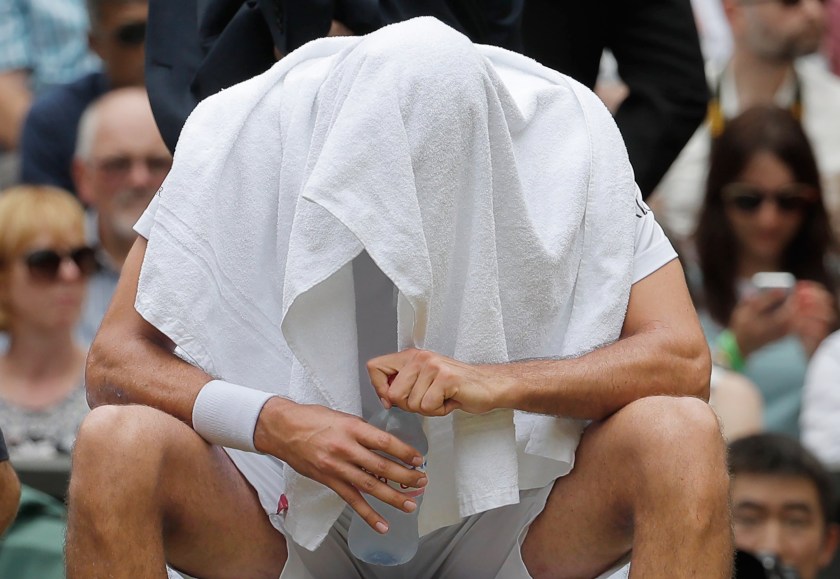
P.S: The picture with this post is not of Federer but of Marin Cilic (crying) after he lost the 2017 Final to Federer.
“Before enlightenment, chop wood, carry water. After enlightenment, chop wood, carry water.”