A few mornings ago, at the end of holding a particularly strenuous Yoga pose, my brother let out a gasp and his back slumped back onto the mat, but it was one of those days when my mind was sharp and still like the tip of an archer’s arrow, and I went to the ground with an even breath and a straight spine — it was the first time it had happened in a long time. Straight away in my ears, I heard the voice of Shaji shouting at me from one end of a really large room – I only said relax, back straight!
The yelling was from a warm morning in the year 2013 after I had just moved to Chennai after taking up the IMS franchise for the city. I had taken a place very close to the miniature beach in Besant Nagar (or Bessie as the locals call it). On one of the very first evenings there I took a stroll around the beach and came upon this structure or building or rather what I think is the best word for it – space.
As soon as I saw it and took in it for a few seconds, I thought, this has to be it — a year before, while in Mumbai, I had read a few articles about the groundbreaking classical dancer Chandralekha and had also seen a video of a piece choreographed by her and that had made a strong impression on me, and on reading more about her, I had discovered that her studio is in Chennai and when I saw this space I was certain that this was it.
Chandralekha is considered groundbreaking because she re-invented or reinterpreted what Bharatanatyam can mean through the lens of an even older art form, one that is considered a precursor to all the South East Asian martial arts — kalarippayattu. Shaji, a young practitioner and teacher of kalarippayattu, was one of the two people in the piece choreographed by Chandralekha that I had watched, the other was the writer Tishani Doshi.
So, when I saw the place, I made up my mind to go in and find out if they taught the laity, it turned out that they did and before long I was inside.
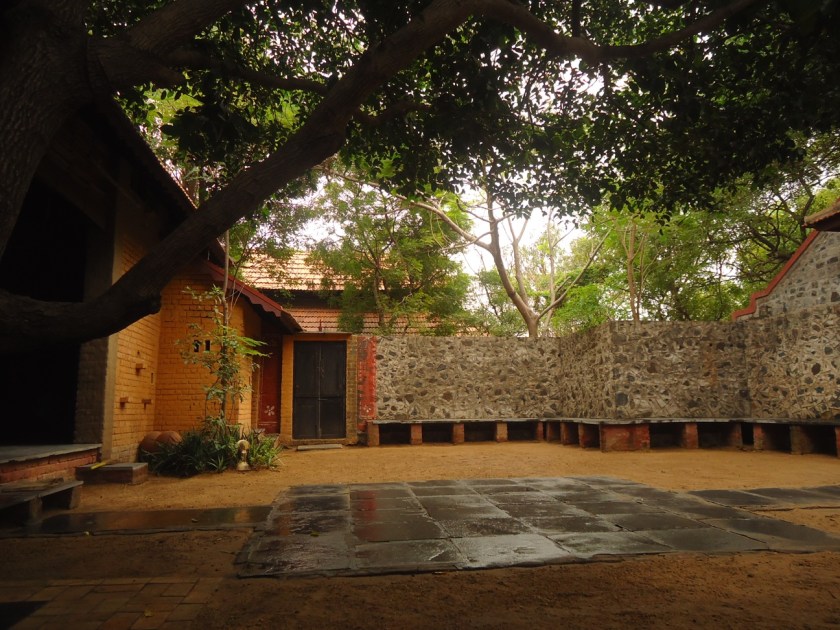
Shaji was as old-school a perfectionist as one could get for a teacher. He would spend a long time arranging and re-arranging students in what seemed to be a random asymmetrical order. Looking back I am guessing it was to ensure that he could sight each one of the 30-odd students who turned up at 6 A.M. from places that were as far as two hours away. He rarely uttered a word apart from the instructions for the movement in Malayalam (like it is in the Japanese way there is very little active teaching, you are expected to watch, follow, and execute until you get a hang)
The session opened with a 30-minute, non-stop movement & kicks-based warm up by the end of which my lungs were ready to explode, and it was on one of those initial days when he had said relax at the end of the warm-up that I slumped against the wall, breathing audibly (to myself) — that was when he shouted at me.
After about 15-odd sessions I gave up because I realised that very few of the students who came there were amateurs like me. Many of the students were dancers who did this for strength and flexibility, while others were full-time students of Kalari who stayed there for a better part of the day. I felt that unless I was serious about pursuing it as an art form, which would take more than the 90 minutes of everyday class that I was putting in, I would be disrespecting it and it was obvious that they were not teaching the classes for the money (else they wouldn’t have been charging a meagre 500 per month). And given that I had just invested money to get into a business, there was no way I could give any more than 90 minutes a day, which in itself seemed difficult on most days.
But what I learned from those few sessions was immense. Firstly, commitment to something is not limited to being strong-willed enough to turn up for the mandated session. True commitment means managing one’s energies during the rest of the time in such a way that you are fully switched on during the time you are present (people rarely understand this, we think as long as we are turning up for something regularly despite our super-busy schedules, we are committed). But whenever you are late for something, have only somehow managed to reach on time, it is very clear that your commitment to the same is only that much — 18-carat not 24-carat. If you are fully committed you will always be slightly early, you would have collected your thoughts and are absolutely ready to dive in.
The second learning is completely related to making the commitment happen. I first started reading about, becoming more aware of my breath and practising pranayama, in the year 2007. I had read a few really good books and practised intensely for close to three years. But I never really made it a part of the rest of my workout routines be it weight-training or yoga.
Over the years, I have realised that as far as managing our mental and physical energies is concerned, breath is everything. When I was getting into a series of strenuous poses today, I was constantly aware of my breath, or rather my focus was both on the pose and on my breath, the focus was to ensure that I did not take shallow breaths, which for me personally, during a pose, has always meant exhaling fully rather than inhaling very deeply (unless the pose itself demands otherwise). This ensures that when I have to respond to the instructor’s call to hold a pose for 30 seconds I measure it in breaths — I know that 10 seconds more is just two breaths more and my focus goes back to my breathing. It also ensures that the core is tight since you are emptying your abdomen out fully, this results in the spine being straight and this results in the most important thing — you do not slump and hit the floor at the end.
Each time you slump with a gasp, you expend more energy and more importantly, you release your focus. Each time you go down with an even breath and straight spine, you are ready for the next pose without releasing your focus, you do not give up before the end of the count.
Do you slump at the end of a section or a DI-LR set?
Is your focus as sharp and as still as the tip of Karna’s arrow, Achilles’ spear for the entire duration of the CAT?
If you have seen the eyes of swimmers when they step out, during the period before they bend down to get on to their marks, you will know that their gaze is always elsewhere, they are not looking at anyone or anything, as if their body and mind are fused into one.
This has to be the case with all sports that require sustained unbroken energy and concentration from start to end, say sprinting, swimming or archery, unlike longer-format sports like say cricket or football where you can afford to take breathers and recoup but even in those sports, teams and players, are most likely to falter after a scoring a century or a goal, a tennis player is most susceptible in the game after he or she breaks serve, because they let the focus drop, let the breath go, let the spine slacken.
Have you seen the video of Maradona’s gaze before the start of the 86 Final (or SF or QF) as he makes the sign of the cross? Did you see how Stokes went about his innings, how he cut everything out and did not celebrate after the century? Have you seen Djokovic go into monk mode? All of these point to the same thing – focus – even breath, tight core, and straight spine, and that is why in all martial arts, they tie a cloth around the waist.
Some of you might have trouble concentrating for the entire duration of the test. Some of you might be able to easily concentrate but are leaking energy during the process. Some of you might be hitting your desired scores. I feel that no matter where you are, developing an awareness of your breath through breathing exercises (which will mean that your spine will have to be straight), and learning to manage your mental & physical energies through that awareness, will always give you a jump in scores and if the paper gets tougher you will have enough fuel left in your tank and a few more gears left in the mind.
I found that while I learnt this years ago, I have not always applied this diligently, I did it for some years at a stretch and for some, I let go, and unfortunately, I let go when my schedule was the most hectic, which was when I needed it most. All of us can work out, do yoga, and eat right when our schedules are light, it is when we manage to do the right things in the middle of a storm that the storm itself becomes manageable.
So my advice going into the last few months of the CAT Prep is that you need to focus on making your energies one-pointed; you need to add breathing exercises to the beginning and the end of your day; you need to get some form of physical exercise to get your lungs pumping at a rate higher than normal, even if it is a brisk walk, at least a couple of times a week; you need to learn to relax by taking in the right things, say reading Siddhartha by Hermann Hesse; you need to remove a few things as well such as social media apps (including the YouTUBE App), there is nothing happening on them that is more important to your life than getting into an IIM (essentially you need to get rid of all forms of sugary and fried food that you are feeding to your brain).
If you do all of these things and are conscious of the way you expend your breath and your time over the next three months, you will not slump with a gasp, the spine will be straight, and the breath will be even regardless of the depth — you always be ready for the next ball — and like Arjuna you will not see the sky, or the trees, or the bird, but see only blackness,
the blackness
in the centre
of the eye of the bird.